- The voice
- Five or six soft breaths out, never together
- Home
- The Luna LagunaWhere the lake stops being a lake — the first warm water, and the moon in it before you look up
- Part of
- Sleep namesA character per sleep word, so the word is learnt without being taught.
The story of The Sleepatees
There is never one Sleepatee. They come as a raft — five, six, seven of them, all different sizes, all facing the same way, gently overlapping in the warm shallows at the far edge of the Luna Laguna.
The word for a group of them is an ease. An ease of Sleepatees.
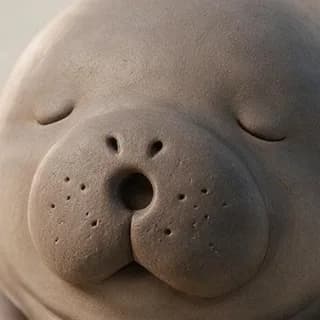
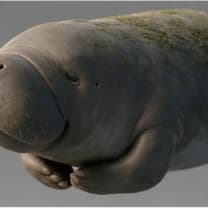
Each one is a big soft rounded loaf of matte grey-taupe clay with no edges anywhere on it, a blunt whiskery muzzle, two very small very calm closed eyes, and one wide flat rounded paddle of a tail. And two small flippers resting together on the chest, like folded hands.
That last one came from a photograph and nobody would have thought of it: it is a sleeping posture a small child reads instantly, without being told what it means. Their method is a fact about the real animal, and it is the best fact in the cast.
A manatee sleeps and breathes at the same time. She drifts just below the surface, comes up for air, and goes back down — still asleep the whole way through.
She never has to wake up to do it. Which is, more or less exactly, the thing a child at three in the morning is failing to manage.
And because they are a group, they do something no single body could. Each one breathes on a different slow count — one every seven seconds, one every eleven, one every thirteen, one every seventeen — so one is always rising as another sinks, and the pattern of the raft does not repeat for hours.
It is the drift arithmetic the whole world is built on, turned into a living thing you can watch. Nothing else in the picture moves at all.
One of them is almost white. She is never mentioned and never pointed at.
She is simply there, the same one every time, and a child finds her on about the fifth viewing, on their own.
Also from The Luna Laguna
The Sleepatees is part of the World of Tardy: bedtime stories for kids, told slowly, one calm place at a time.