
- The voice
- None needed; the eye does the talking
- Home
- The Sleepy SeaIt breathes. Heard, never arrived at
- Part of
- SleepThe ones whose whole job is getting you there.
- How home goes to sleep
- It goes to sleep when it goes flat and mirrors the Sleepy Lights.
The story of Dreamy Dolphin
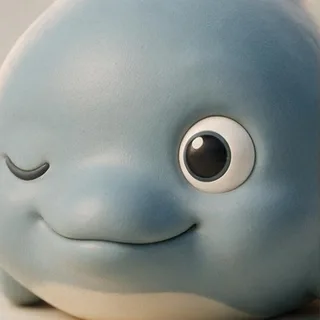
He is asleep and awake at the same time, and he is smiling about it.
The contradiction
He is the only creature in the world who is both. The Dreamy Dolphin — out in the Serene Sea, nearer the shore than the whales — sleeps with one half of his brain while the other half stays up, one eye closed, one eye open, and the same calm smile on his face whichever eye you are looking at.
Every other sleeper on the route is either going under or gone. The dolphin is under and up at once, and always has been, and it is the single fact a parent takes home from the end of the route.
Their personality
Awake, which is to say half awake, he is unbothered and amused. He is the calmest thing in the sea, because nothing can surprise a creature who is already asleep and already up.
He drifts nearer the shore than the whales, smiling the same smile from both sides, and he seems to find the whole arrangement quietly funny, which it is. One eye is shut and one is open, in every frame, and the smile does not change.
Their sleep
Half of him is awake, and the awake half makes no Z. He rises, slowly, breathes once at the surface, and sinks, slowly, and that is his only motion.
One eye is open the whole time. He is not keeping watch on you; he is keeping watch on nothing, the way a dolphin does, with the half of him that is on duty, while the other half dreams.
How they got so good at this
He was born knowing it. Every dolphin is; it is not a trick, it is how the animal is made.
What he learned was to come close enough to the shore to be seen doing it. The whales stay out where they can be heard and not seen, and that is right for whales; but a fact needs a picture, and a picture needs to be near enough to look at.
So he came in, one night, to the edge of the last wave, and turned his open eye to the shore, and has been there since, the one thing at the end of the route you can actually see.
Their method
He is the fact. The whales carry the sound of the Serene Sea; the dolphin carries the thing a parent leans over and says: a dolphin sleeps with half its brain at a time, and keeps one eye open. That is true, and it is also a drawing — one eye closed, one eye open, still smiling — and a child who hears it at the end of the route has learned that sleeping is not all-or-nothing, that you can be a little bit asleep, that half is allowed.
Half is a very easy place to start.
Their challenge
He can never be entirely asleep, and this is a world that is all about getting there. He is the only sleeper on the route who never reaches the bottom of the ladder, and the only one who never has to.
It means he can never take part in a Sleep Off, because half of him would always be disqualified.
Their arc
He does not descend, because half of him is already there. What descends is which half.
Through the piece the open eye gets narrower, and the closed one stays closed, and at the end the open eye is still open, a slit, watching the shore where the child was, and the child is asleep and he is exactly as he started.
The true thing
Dolphins really do sleep with half their brain at a time. Scientists who recorded the brainwaves of sleeping dolphins found one half of the brain in deep slow sleep while the other half stayed awake — and then, after a while, the halves swap.
The eye on the awake side stays open; the other closes. It is how a dolphin can sleep and still surface to breathe, still swim, still watch.
The Dreamy Dolphin's one open eye is not a cartoon wink. It is the truest drawing in the sea.
Source: Mukhametov, Supin & Polyakova, "Interhemispheric asymmetry of the electroencephalographic sleep patterns in dolphins", Brain Research 134(3), 1977; Lyamin et al., "Cetacean sleep: an unusual form of mammalian sleep", Neuroscience & Biobehavioral Reviews 32(8), 2008.
What they like, and what they do not
He likes the edge of the last wave, where he can be seen. He likes being the fact.
He likes the whales' song from a distance, and the distance. He does not like being asked which eye is the real one, because both are, and he does not like the deep water past the whales, where there is nothing to look at with the open one.
Tardy and them
They have never met. The Serene Sea is heard and never arrived at, and Tardy has never got that far; the dolphin's fact reaches the shore without him.
If they ever share a frame, the small one will be all the way asleep and the grey one will be half, and both will be smiling.
Their friends
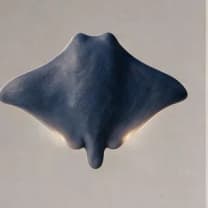
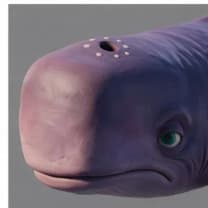
The Serene Sea is his home, and in the Serene Sea sharing the water is the same as sharing a home: the Mauve Whales, standing on end in the deep water further out, and the Sleep Ray, passing wide and pale beyond the last wave.
The quiet detail
Which eye is open changes. Not in one film — but from film to film, the halves swap, because that is what real dolphins do.
Nobody says so.
Also from The Sleepy Sea

Dreamy Dolphin is part of the World of Tardy: bedtime stories for kids, told slowly, one calm place at a time.